
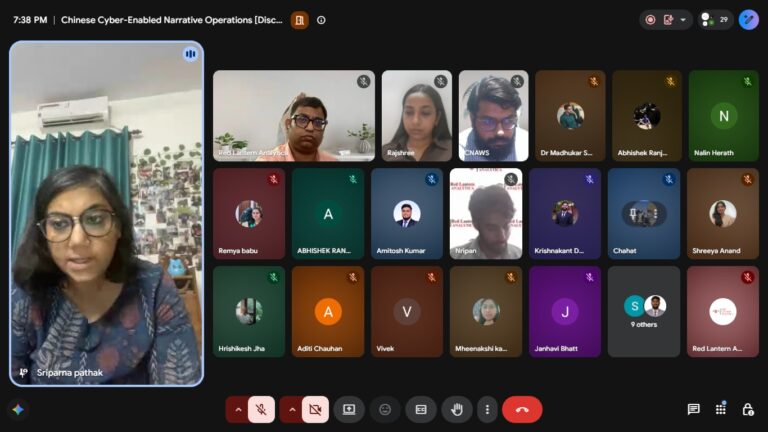
New Delhi, August 2, 2026: Red Lantern Analytica organised a discussion and report-release event titled “Chinese Cyber-Enabled Narrative Operations”, bringing together experts in China studies, cybersecurity, information warfare and strategic affairs to examine the growing use of digital platforms for influencing public opinion and weakening confidence in democratic institutions.
The event also marked the release of Red Lantern Analytica’s report, “Chinese Cyber-Enabled Narrative Operations Around India’s 2026 Student Protest.” The study examines how domestic protests and public grievances in India were reframed across Chinese-language and international digital platforms as evidence of governance failure, institutional decline and political instability.
The discussion featured Professor Sriparna Pathak, Professor of China Studies and Founding Director of the Centre for Northeast Asian Studies at O.P. Jindal Global University; Dr Madhukar Shyam, Assistant Professor in the Department of International Studies, Political Science and History at CHRIST (Deemed to be University), Delhi NCR; and Mohit Vashish, Founder and Executive Director of Intelligence at the Centre for New Age Warfare Studies.
Opening the discussion, Professor Sriparna Pathak said Chinese narrative operations extend beyond attempts to influence elections or promote favourable perceptions of China. Their wider objective, she observed, is to polarise societies, amplify existing grievances and gradually undermine public trust in democratic institutions. She explained that such campaigns frequently rely on inauthentic social-media accounts, artificial intelligence-generated content, state-media proxies and fabricated digital personas. Open democratic information systems are particularly vulnerable because foreign narratives can circulate with relatively few restrictions, while China maintains a highly controlled domestic information environment. Professor Pathak noted that India has emerged as both a strategic target and a testing ground for these operations, particularly since the June 2020 Galwan Valley clash. Narratives linked to Chinese digital ecosystems have sought to question India’s military preparedness, intensify ethnic and regional tensions and portray democratic disagreements as evidence of political instability.
Referring to campaigns concerning Northeast India, she highlighted attempts to exploit developments in Manipur, Nagaland and Arunachal Pradesh. Chinese-origin content, sometimes translated or adapted using artificial intelligence tools, has been circulated to amplify separatist claims, distort local grievances and complicate India’s border-management challenges. She also referred to bot-like accounts that sought to undermine confidence in the 2024 Lok Sabha elections by raising doubts about national security, governance and defence capabilities. Professor Pathak called for faster official responses, greater platform transparency, improved public-reporting mechanisms and media-literacy programmes in Indian languages.
Dr Madhukar Shyam distinguished conventional cyberattacks from cyber-enabled narrative operations. While technical cyberattacks are designed to penetrate, disrupt or damage computer systems, narrative operations use the digital environment to shape emotions, attitudes and political perceptions. He referred to earlier cyber-espionage campaigns, including the 2009 GhostNet operation, which compromised computer systems across several countries and reportedly targeted institutions connected with the Tibetan community. He also discussed the Shadow in the Cloud investigation and cyberattacks against Tibetan institutions, illustrating the relationship between technical espionage and long-term information warfare.
Dr Shyam further examined how Chinese messaging sought to exploit India’s 2024 National Eligibility-cum-Entrance Test controversy. Comparisons between China’s Gaokao examination and India’s NEET system were used to present protests and administrative disputes as evidence of systemic democratic failure. Such narratives, he said, deliberately misinterpret public protests, which are a normal feature of democratic accountability, as signs of political collapse and institutional instability.
He also drew attention to attempts to manipulate cultural and civilisational narratives, including efforts to weaken India’s historical association with Buddhism and create differences between India and neighbouring countries.
Mohit Vashish explained the operational structure of contemporary Chinese information warfare, describing it as a systems-based approach in which intelligence gathering, psychological profiling, content creation, social-media amplification and influencer engagement operate in coordination. According to Vashish, intelligence agencies and associated organisations first identify societal “fault lines”—issues capable of dividing communities—and then use psychological techniques to intensify those divisions. Anonymous posts may initially be amplified through bot networks and subsequently repeated by influencers, media platforms or political commentators, giving manufactured narratives an appearance of credibility and organic public support.
He also warned that foreign-linked entities may approach students, researchers and young professionals through professional networking platforms such as LinkedIn. Individuals studying defence, international relations, security and political science may be offered unusually high payments for reports or research assignments. Vashish advised students and researchers to verify email addresses, carefully examine domain-name spellings, check the organisation’s official website and remain cautious about unsolicited financial offers. He also recommended reviewing suspicious accounts’ biographies, posting histories and interaction patterns, tracing the earliest appearance of particular phrases and conducting reverse-image searches before sharing sensational content.
Presenting the findings of the report, Daney Antonio Martin of Red Lantern Analytica said the research examined content circulated through Chinese and international platforms, including WeChat, Weibo, Guancha and X. The report found no evidence that China initiated India’s 2026 student protests. It nevertheless identified strong evidence that Chinese digital ecosystems exploited and amplified the protests to advance broader geopolitical narratives about India. The study distinguishes between direct instigation and narrative exploitation. It assesses the evidence for coordinated amplification as substantially stronger than any claim of centrally directed technical interference in the protests.
The speakers agreed that foreign narrative operations cannot be addressed solely through government regulation or technical cybersecurity measures. They called for a whole-of-society approach involving government agencies, digital platforms, researchers, educational institutions, journalists, civil-society organisations and citizens. The discussion underlined the need for rapid public communication, transparent platform practices, stronger verification systems and greater digital awareness among users. Participants also emphasised that democratic openness should not become a vulnerability that foreign actors can repeatedly exploit.
The session concluded with a vote of thanks to the speakers, moderator, participants and organising team for contributing to the discussion on safeguarding India’s information environment.
About Red Lantern Analytica
Red Lantern Analytica is a New Delhi-based international observers and research organisation working on China, Tibet, the Indo-Pacific, cybersecurity, disinformation, strategic affairs and emerging geopolitical challenges. Through research reports, expert dialogues and public engagement, it seeks to promote informed debate and policy-oriented analysis.
