
Why Arunachal Pradesh and Pasighat Matter:
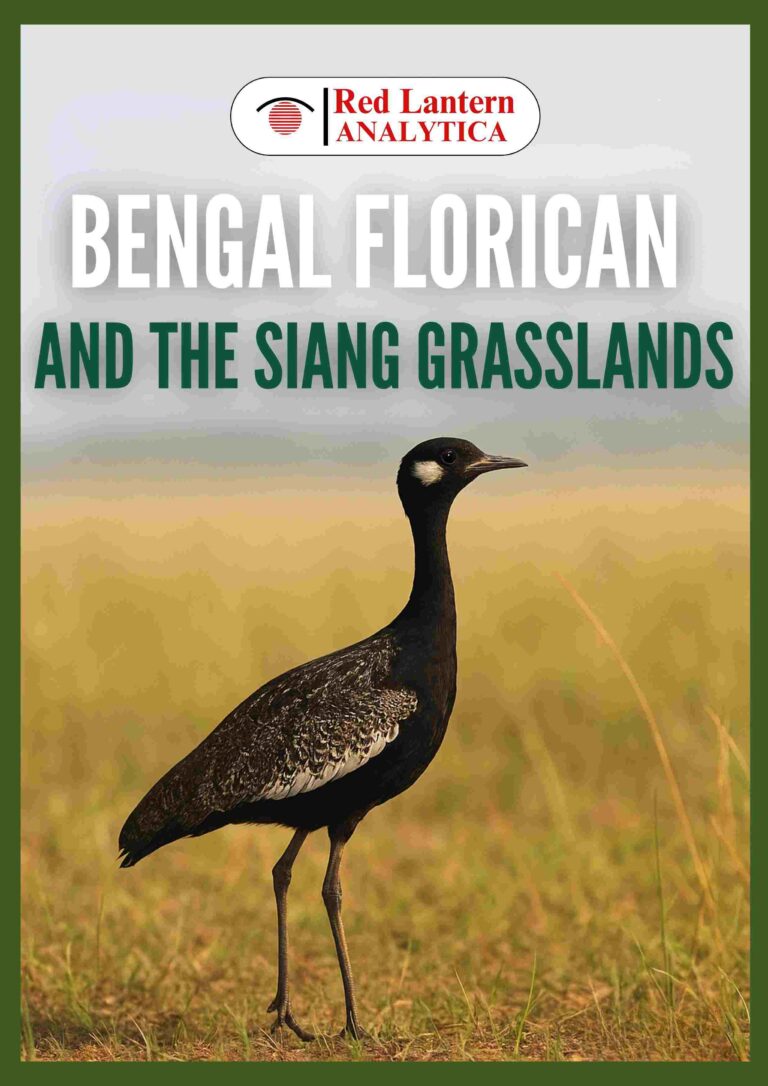
The Bengal Florican (Houbaropsis bengalensis) is the rarest bustard on Earth and one of the most evolutionarily distinctive birds anywhere. It belongs to a single-species genus, which makes its branch on the tree of life unusually isolated: if it disappears, there is nothing quite like it to take its place. Globally the species is classified as Critically Endangered, with a total population likely under a thousand mature individuals, split between South Asia and Cambodia (with a faint historical footprint in Vietnam and Bangladesh). The steep decline is driven by the loss and degradation of seasonally flooded grasslands, woody encroachment when fire and grazing patterns change, disturbance in the breeding season, and (in parts of its range) hunting and snaring. (BirdLife DataZone, EDGE of Existence)
This report explains—in plain language but with research depth—why Arunachal Pradesh, especially the grassland archipelago around Pasighat and Daying (D’Ering) Ering Memorial Wildlife Sanctuary, is vital to the Florican’s survival, what we know about its ecology and movements in the Siang floodplain, what’s threatening the bird and its habitat, and how conserving it is inseparable from conserving the ecology, culture, and identity of Northeast India’s riverine grasslands.
Rather than a “project plan,” what follows is a reader’s guide to the species and landscape: the big picture, the local picture, and the cultural picture—stitched together with the best available sources.
Meet the bird: a specialist of floodplain grasslands:
If you stood on a Pasighat river island (a chapori) in late spring, just as the monsoon hints at arriving, you might—if lucky—see a male Bengal Florican lift vertically above the grass with a sudden flutter, black-and-white wings flashing, crest upright, and then drop back into invisibility. That display, repeated at intervals, is how males advertise territories. Everything about the species is tied to grass structure and seasonality. It needs:
●Open sightlines for males to display (short-to-medium sward height in patches).
●Dense, concealing tussocks for females to nest and brood.
●Invertebrate-rich foraging among lightly disturbed swards and damp edges.
●A natural flood pulse that periodically resets woody growth and creates a shifting mosaic of islands and grass stands.
Across its range, the Florican is not a long-distance migrant like geese or cranes. Instead, it makes short, seasonal movements—often a few to a few dozen kilometers—tracking flooding and grass height. In the Brahmaputra–Terai system and around Cambodia’s Tonlé Sap, birds occupy open breeding grounds in the dry season and then retreat to safer cover as monsoon waters rise; some individuals in Nepal have been tracked moving up to ~30 km, even slipping across international borders for seasonal refuge. For Pasighat, that means the bird’s year is lived within a network of chapori grasslands, not a single site. Protect the network, and you protect the bird. (Mongabay, Charles Sturt University Research Output)
Why Pasighat–Siang is a cornerstone:
Daying (D’Ering) Ering Memorial Wildlife Sanctuary lies just 13–25 km from Pasighat, spread over roughly 190 km² of river-created islands between the Siang (the Upper Brahmaputra) and the Sibya. About 80% of the sanctuary is grassland, with the remainder riverine and secondary forest—textbook Florican country when managed with seasonal sensitivity. BirdLife International recognizes D’Ering as an Important Bird Area (IBA) precisely for floodplain specialists, including the Florican and the endemic Swamp Grass Babbler. The sanctuary’s chaporis, remade each year by erosion and deposition, deliver the habitat heterogeneity—short swards here, taller stands there—that the species’ breeding and brood-rearing require. (BirdLife DataZone, Roundglass Sustain, Wikipedia)
Yet the very dynamism that sustains these grasslands is now tilted against them. New analyses and reportage indicate that D’Ering lost ~55.9 km² of grasslands between 2012 and 2022— a massive contraction in one decade—driven by altered flood regimes, riverbank erosion,siltation patterns, and a suite of human pressures (from unseasonal burning and cutting to encroachment). For a bird that lives by the square kilometer of suitable sward, that loss is existential. (Mongabay-India)
The threats explained:
It’s easy to assume “grass grows back.” Floodplain grasslands, however, are not lawns. They are intricate systems shaped by water timing, sediment, fire, and grazing. Damage the rhythm, and the system flips.
●Hydrology out of tune. Flood pulses that linger too long scour and drown islands; pulses that arrive too erratically let woody plants take over. Either way, you lose the patchy openness males need for display and females need for safe nesting. The Siang’s recent patterns—erosion in one set of chaporis, silt burial in another—show up vividly in remote-sensing assessments and in ground reports from D’Ering. (ResearchGate)
●Ill-timed fire and cutting. Fire and mowing are not inherently bad. In fact, well-timed, light burns before breeding can restore open display arenas, and post-breeding rotational cutting can prevent shrubs from taking over. But late fires (March–August) cook nests and expose chicks; blanket cutting destroys heterogeneity. Nepal’s 2024– 2033 Florican plan and case studies from Cambodia lean heavily on seasonal grass management for this reason. (National Parks and Wildlife, Mongabay)
●Invasive and woody encroachment. Where fire is suppressed and grazing changes, woody clumps and exotics can fill in. The result is a “too-tall, too-dense” structure— bad for display, awkward for ground-nesting birds, and risky in monsoon. (This is a general grassland phenomenon, but it has particular bite for Floricans.) (Roundglass Sustain)
●Disturbance and hunting. In parts of Southeast Asia, hunting has been devastating. In the Indian and Nepali context, disturbance during the breeding season—including dog predation on ground nests—can be a big, invisible killer. Even occasional hunting pressure magnifies risk when a population is tiny to begin with. (Mongabay)
●Land conversion at the margins. Floodplains worldwide are magnets for agriculture. Where chaporis stabilize, they are tempting to convert; where they stay dynamic, they’re hard to govern. A sanctuary boundary helps, but a bird that moves seasonally among multiple islands needs friendly practices outside the boundary as well. (BirdLife DataZone)
Ecology meets identity: why this bird is “of” the Northeast:
The Brahmaputra–Siang floodplain is more than a map feature: it is a civilization of water, silt, reeds, and boats that has shaped languages, foods, houses, and ritual life for millennia. In this living landscape:
●The Mising people of Upper Assam (close neighbors across the braided channels) and communities of East Siang, including the Adi, have developed flood-adapted lifeways: stilt houses (chang ghar), seasonally shifting agriculture, woven reed crafts, and water mobility. These are not “old-fashioned quirks”; they are climate-smart technologies for a river that changes its mind each year. Preserving chapori grasslands—sensibly, seasonally—preserves the stages on which these cultures perform their everyday resilience. (PreventionWeb, Global Voices, Mongabay-India)
●Across Arunachal, there is a powerful shift afoot from hunting to stewardship, expressed through community-conserved areas (CCAs) and village-level rules. The Idu Mishmi helped pioneer CCAs to protect ancestral forests and wildlife, and Adi villages near the Siang have adopted hunting restrictions and seasonal bans—initiatives increasingly recognized in the state’s new biodiversity strategy (2025), which emphasizes bottom-up, customary governance alongside statutory law. This isn’t a “nice-to-have”: when >80% of forests are under community tenure, conservation succeeds only if communities lead. The Florican’s seasonal patchwork ecology fits naturally with such community-led stewardship. (Mongabay-India, Down To Earth, WTI)
In short, saving the Florican is not a niche birdwatcher’s project. It is about honoring and future-proofing a floodplain culture—a heritage of stilt houses, chapori crafts, and river knowledge—while keeping a unique, evolutionarily distinct species alive.
What we should do:
Think of the following as principles—clear enough for the lay reader, grounded enough for a scientist:
●Seasonality is everything. No burning, mowing, or heavy grazing during the breeding window (roughly March–August). Use light, patchy burns and staggered cutting in the cool months to produce a quilt of short and medium swards before display begins. This aligns with best-practice guidance distilled in Nepal’s national plan and from Cambodia’s Tonlé Sap experience. (National Parks and Wildlife, Mongabay)
●Think in networks, not dots. A single “good” island is not enough. The Pasighat Florican likely uses multiple chaporis as water levels, grass growth, and disturbance shift. The management unit, therefore, is a mosaic: D’Ering’s core plus village lands that function as seasonal refuges. BirdLife’s IBA framing and the Key Biodiversity Area listing for D’Ering emphasize this landscape logic. (BirdLife DataZone, Key Biodiversity Areas)
●Use culture as conservation infrastructure. Build on Adi and neighboring communities’ self-imposed bans and customary rules to set quiet hours, no-dog zones in breeding time, and no-harvest windows for thatch in key leks. Recognize and celebrate these accords publicly—because legitimacy saves nests. (WTI)
●Restore grasslands as living systems, not static lawns. Restoration is not “plant and forget.” The best evidence from temperate and tropical grasslands is that post- restoration management—mowing once a year, light cattle grazing, and rotational burns—decides whether biodiversity returns and stays. The details for riverine grasslands differ, but the principle holds strongly: structure and timing trump one- off planting. (PMC)
●Target the invisible killers. Free-ranging dogs wipe out ground nests; drones and loud boats disrupt displays; a single late burn can erase a season’s breeding. Simple, community-backed measures—sterilization drives, seasonal leash/curfew norms, and no-drone zones—pay huge dividends for eggs and chicks. (This is repeatedly stressed in South Asian grassland bird work, and echoed in field notes from the Siang.) (Mongabay)
●Count what matters, when it matters. Floricans are easiest to detect when males display (roughly March–May, varying with spring weather). Standardized dawn/dusk counts on fixed transects or vantage points, repeated annually, are the backbone of every effective plan from Nepal to Cambodia. A handful of weeks, done well, can anchor the whole year’s understanding. (National Parks and Wildlife)
These principles do not require bureaucratic complexity. They ask for clarity of seasons, respect for customary authority, and basic scientific discipline.
Zooming in: D’Ering (Pasighat) as a classroom for grassland literacy:
Let’s use D’Ering to make the ecology tangible for a first-time visitor:
●What you’re seeing. Those wide, tawny islands are not “wastelands.” They’re flood- built prairies whose grasses (Saccharum, Imperata, Desmostachya) hide deer fawns and Florican nests. The ragged edges where a channel nips at an island? That’s erosion- creation at work—destroying here, building there—and the cycle is what keeps the sward open for display.
●How to tell “good” Florican habitat at a glance. In late March, scan for patches where grass is knee-high to chest-high, with open lanes for the male’s vertical display. If you see dense, shoulder-high clumps everywhere with saplings poking through, that’s a lek lost to woody encroachment or simply to the wrong burn/cutting schedule.
●Listen for the politics in the wind. If locals tell you “this island was forest five years ago” or “that one used to be all grass,” believe them: chapori politics—who burns when, who grazes where, who harvests thatch, how bank protection is built—determine how much “good grassland” survives at any given time.
●Watch your ethics. If you boat into chaporis to look for a display at dawn, remember you’re entering a nursery. Keep distance, keep quiet, keep dogs off, keep drones down. The goal is to leave no trace but your awe.
A people-first narrative for conservation communication:
For an “average Joe” in Pasighat or Assam who has never heard of the Florican, the message resonates when it starts at home:
●“This is our bird of the grass seas.” The Florican is the flagship of a habitat that also shelters fishing, grazing, and reed crafts; it is to Siang chaporis what the tiger is to sal forests. BNHS describes it as an indicator of healthy floodplain grasslands in the Brahmaputra and Ganga systems: when it’s present and breeding, the grassland is working. (Mongabay-India)
●“Our houses are grassland houses.”Chang ghar stilt homes—iconic across the floodplain—draw their materials and logic from grass and water. Preserving sustainable thatch harvest windows outside breeding season keeps both culture and bird intact. (PreventionWeb, Mongabay-India)
●“Our rules save nests.” When a village sets quiet hours in breeding season, controls dogs, and agrees not to burn or cut at the wrong time, eggs hatch. The new Arunachal State Biodiversity Strategy (2025–2035) explicitly encourages such customary, village-led measures—giving bureaucratic muscle to local wisdom. (Down To Earth, apbb.in)
●“Our pride travels.” A carefully curated, low-volume birding circuit—led by local youth trained as guides, with strict seasonal closures around leks—can become a Cultural + Nature itinerary that pays for stewardship. The IBA/KBA status of D’Ering gives international recognition to this pride. (BirdLife DataZone, Key Biodiversity Areas)
What a “Florican-safe” Pasighat year looks like:
To make this concrete for any reader—or local school that wants to build a poster—here’s a
season-by-season storyboard:
●December–February (Prep the Stage): Use light, patchy burns and staggered mowing to open display arenas while keeping nearby cover. Map last year’s leks and adjust. Avoid wholesale burning.
●March–May (The Dance):Display season. Quiet zones around known leks; no drones, no dogs, minimal human presence at dawn and dusk. Conduct standardized counts with trained local volunteers to record presence and behavior.
●April–July (Nests and Chicks):No cutting or burning. Keep boats slow and distant around sensitive chaporis; run dog-sterilization and leash efforts; use signage co- designed with villages.
●August–October (High Water, Hideouts): Birds shift to refuge patches with adequate cover. Use remote-sensing + local knowledge to track which islands remain usable as water peaks.
●November (Reset and Repair): Review data with communities; celebrate successes; plan the next pre-breeding sward management.
You don’t need a grant to follow this logic. You need shared calendars, simple maps, and community resolve—all of which already exist in the Siang floodplain’s lived culture.
The bottom line:
The Bengal Florican’s survival hangs on a paradox: it needs a landscape that changes (flood- built chaporis) to keep its grasslands open, and it needs people who can change with the landscape—adapting fire, cutting, grazing, dogs, and disturbance to the bird’s calendar. Pasighat and D’Ering still have the raw materials: extensive, functioning chapori grasslands; a public that understands rivers; communities already moving from hunting to stewardship; and a state biodiversity strategy that recognizes customary law as conservation muscle.
What is missing is not knowledge of what to do—it’s the habits of doing it at the right times, in the right places, together.
If the Siang’s people set those habits—quiet mornings in April, no fires in May, dogs on leashes through June, and smart, patchy burns in January—the Florican will keep rising, black-and-
white, above the grass seas each spring. And the Northeast will keep a living emblem that binds
ecology, culture, heritage, and identity into one unmistakable silhouette.
References (with web links):
●BirdLife International. Species factsheet: Bengal Florican (Houbaropsis bengalensis).
https://datazone.birdlife.org/species/factsheet/bengal-florican- houbaropsis-bengalensis (BirdLife DataZone)
●BirdLife International. Important Bird Areas factsheet: D’Ering Memorial Wildlife Sanctuary.
https://datazone.birdlife.org/site/factsheet/d%27ering-memorial-wildlife- sanctuary (BirdLife DataZone)
● Key biodiversity Areas Partnership. KBA factsheet: D’Ering Memorial Wildlife Sanctuary (Site 18037).
https://www.keybiodiversityareas.org/site/factsheet/18037 (Key Biodiversity Areas)
●Government of Arunachal Pradesh (East Siang District). Daying Ering Memorial Wildlife Sanctuary (tourism page).
https://eastsiang.nic.in/tourist-place/daying-ering- memorial-wildlife-sanctuary/ (East Siang District)
●Bhattacharya, B.K., & Saharia, J. (2023). Grassland loss threatens endemic birds in Arunachal sanctuary.Mongabay-India (Nov 30, 2023).
https://india.mongabay.com/2023/11/grassland-loss-threatens-endemic-birds-in- assam-sanctuary/(Article reports ~55.91 km² grassland loss 2012–2022 in D’Ering WLS). (Mongabay-India)
●RoundGlass Sustain (2024). Birds of Arunachal Sanctuary Threatened by Loss of Grasslands (Daying Ering WLS).
https://roundglasssustain.com/conservation/daying- ering-wildlife-sanctuary (Roundglass Sustain)
●DNPWC, Government of Nepal (2024). Bengal Florican Conservation Action Plan 2024–2033 (official PDF).
https://dnpwc.gov.np/media/publication/Bengal_Florican_Conservation_Action_Plan_2024-2033_2_July_2024_1.pdf (National Parks and Wildlife)
●Inskipp, C., Poudyal, L.P., Chaudhary, D.B., Shahi, R., & Baral, H.S. (2024). Overview of status and conservation of Bengal Florican (review). https://researchoutput.csu.edu.au/files/598485533/Inskipp_C._Poudyal_L._P._Chaudhary_D._B._Shahi_R._Baral_H._S._2024_._Overview_of_status_and_conser.pdf(Us eful for movement distances and Nepal context.) (Charles Sturt University Research Output)
●Mongabay (2018). In pursuit of the rare bird that vanishes for half the year.
https://news.mongabay.com/2018/11/in-pursuit-of-the-rare-bird-that-vanishes- for-half-the-year/ (Mongabay)
●WCS Cambodia. Bengal Florican (country program page).
https://cambodia.wcs.org/saving-wildlife/bengal-florican.aspx(Cambodia trends, threats, and coexistence work.) (cambodia.wcs.org)
●EDGE of Existence (ZSL). Bengal Florican profile; Survival Blueprint (India, 2021). Species page: https://www.edgeofexistence.org/species/bengal-florican/ Survival Blueprint PDF:https://www.edgeofexistence.org/wp- content/uploads/2017/05/Survival_Blueprint_2021_BengalFlorican_India.pdf (EDGE of Existence)
●D’Ering Memorial Wildlife Sanctuary—general overview (Wikipedia; compiles references, incl. IBA).
https://en.wikipedia.org/wiki/D%27Ering_Memorial_Wildlife_Sanctuary
●Rahmani, A.R. et al. (2022). Birds of D’Ering Memorial Wildlife Sanctuary, Arunachal Pradesh (annotated list; includes grassland specialists).
https://nieindia.org/Journal/index.php/ijees/article/download/2613/722 (nieindia.org)
●Tölgyesi, C., et al. (2021). Post-restoration grassland management overrides the effects of restoration actions (open access).
https://pmc.ncbi.nlm.nih.gov/articles/PMC9285412/(General grassland restoration evidence on mowing/grazing regimes.) (PMC)
●PreventionWeb / UNDRR (2021). Mising community flood-resilient stilt houses (chang ghar).
https://www.preventionweb.net/news/indias-mising-community-seeks-expand- its-indigenous-adaptation-practices-response-climate (PreventionWeb)
●Mongabay-India (2023). How Assam’s Mising community is coping with floods through architectural design (chang ghor).
https://india.mongabay.com/2023/01/how-assams- mising-community-is-coping-with-floods-through-architectural-design/ (Mongabay- India)
●Wildlife Trust of India (2024). Adi Tribe in Arunachal Pradesh puts restrictions on hunting and fishing (news).
●Down To Earth (2025). Arunachal Pradesh’s new biodiversity strategy—bottom-up, community-led.
https://www.downtoearth.org.in/wildlife-biodiversity/a-landmark- peoples-plan-will-arunachals-biodiversity-strategy-set-a-national-example (Down To Earth)
●Arunachal Pradesh State Biodiversity Board (2025). APSBSAP 2025–2035 (Executive Summary & Full Plan). Executive Summary:
https://apbb.in/wp- content/uploads/2025/04/Executivee-Summary_APSBSAP.pdf
Full Plan: https://apbb.in/wp-content/uploads/2025/04/APSBSAP-main-2025-2035.pdf
●Daying Ering: natural history & access (popular overview).
https://wildtrails.in/daying- ering-memorial-lali-wildlife-sanctuary/(Tourist-oriented but useful for lay descriptions of chaporis and access.) (Wild Trails)
●Mongabay (2025). Nepal looks to Cambodia’s breeding model as numbers plunge—a recent synthesis of threats and remedies. https://news.mongabay.com/2025/09/nepal- looks-to-cambodias-breeding-model-as-bengal-florican-numbers-plunge/ (Mongabay)
To Download beautifully formatted PDF of this report click here.
