
Beyond New Delhi: The Expanding Role of Indian States in Global Diplomacy
Introduction
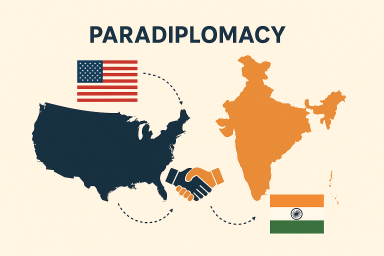
In the past three decades, India’s foreign policy has witnessed significant changes. The economic reforms of 1991, the rise of regional parties and strong regional leaders and several other factors have meant that India’s states have emerged as stakeholders in India’s external outreach – especially the economic aspect[i]. This phenomenon is global and is referred to as para-diplomacy[ii].
While the economic reforms of 1991 and the India’s remarkable achievements in the realm of Information Technology, in the 1990’s and 2000’s, gave a key push to participation of states in India’s economic diplomacy, the rise of strong leaders like Chandrababu Naidu (currently CM of Andhra Pradesh) was also an important factor. Naidu during his tenure as CM of erstwhile AP in the 1990’s and early 2000’s and both his terms (2014-2019, 2024-) as CM of the newly carved out state of AP has been pro-active in reaching out to investors. While during his first term, Naidu reached out to IT giants and was credited for making Hyderabad – now the capital of Telangana into an IT Hub[iii] – as CM of AP he has been reaching out to foreign investors and governments for the development of Amaravati as well as Vaishakhapatnam[iv]. The past decade has also witnessed a growing trend of state investor summits. While PM Modi as CM of Gujarat had started the Vibrant Gujarat Summit, almost all states host Investors Summits – with an eye on drawing foreign direct investments.
One of the important steps taken by the current government to improve coordination between the centre and the states is the setting up of the States Division in the MEA.
There has also been talk of ‘competitive federalism’ between states. The PM himself has often spoken about competitive and cooperative federalism.
After the signing of an FTA between India and UAE, state governments – including West Bengal, Maharashtra[v] and Tamil Nadu — are also trying to strengthen their trade linkages. UAE itself has been reaching out pro-actively to several states for strengthening economic linkages.
While para-diplomacy is a reality and there is no doubt that states have become more pro-active. A few points need to be borne in mind. First, despite there being many mechanisms it is important to have better coordination between the centre and statesand to ensure that politics does not come in the way of issues pertaining to development. Second, in a changing geopolitical and economic situation coordination between centre and states is essential. For instance, on the issue of tariffs imposed by the US on India, there is need for better coordination similarly the decision of the Trump Administration to raise H1B fees will impact IT Professionals and companies. The IT professionals of AP and Telangana are likely to get impacted most and it is important that the central government works closely with both state governments. While Hyderabad has been wooing several IT companies, companies have already shown interest in Andhra Pradesh. India has an opportunity to benefit from the current unpredictability and turbulence. While in the short run there could be problems, in the long run India could benefit from some of the global changes underway, as it has in the past from uncertain situations.
Third, it is important to make states, irrespective of the dispensation in power, stakeholders on not just FTA’s but also initiatives like Act East, Free and Open Indo-Pacific. Even in the context of ties with immediate neighbours, the centre and states need to work closely irrespective of the political dispensation in power in the states.
Finally, in the sphere of higher education there is need for greater cooperation. Several overseas universities are showing interest in developing campuses in different parts of India. Apart from this, the centre and states should also regularly discuss changing trends in the international higher education sector and the possible impact on states.
In conclusion, while there is no doubt that the trend of para-diplomacy has gained momentum in recent years, it is important to ensure that there are mechanisms facilitate strong centre-state coordination on issues pertaining to foreign policy. In a changing economic and geopolitical situation, the role of states is bound to increase and it is important that this is successfully harnessed.
[i] Wyatt, A. (2017). “Paradiplomacy of India’s chief ministers”. India Review, 16(1), 106-124.
[ii] Daily News Analysis, “From 1990s till date, how ‘paradiplomacy’ gained momentum in India”, August 7, 2023. Tridivesh Singh Maini. Weblink: From 1990s till date, how ‘paradiplomacy’ gained momentum in India
[iii] L. Rudolph and S. Rudolph, “The Iconization of Chandrababu: Sharing Sovereignty in India’s Federal Market Economy,” Economic and Political Weekly, Vol. 36 No. 18 (2001), pp. 1541-1552.
[iv] See Wyatt A, 2017. Paradiplomacy of India’s Chief Ministers. P.106-107
[v] The Geopolitics, “India-UAE CEPA: How India’s States Are Tapping Potential Benefits”, March 2, 2024. Tridivesh Singh Maini. Weblink: India-UAE CEPA: How India’s States Are Tapping Potential Benefits – The Geopolitics
Authored by:
Tridivesh Singh Maini,
Assistant Professor,
Jindal School of International Affairs,
O.P. Jindal Global University,
Sonepat, Haryana