
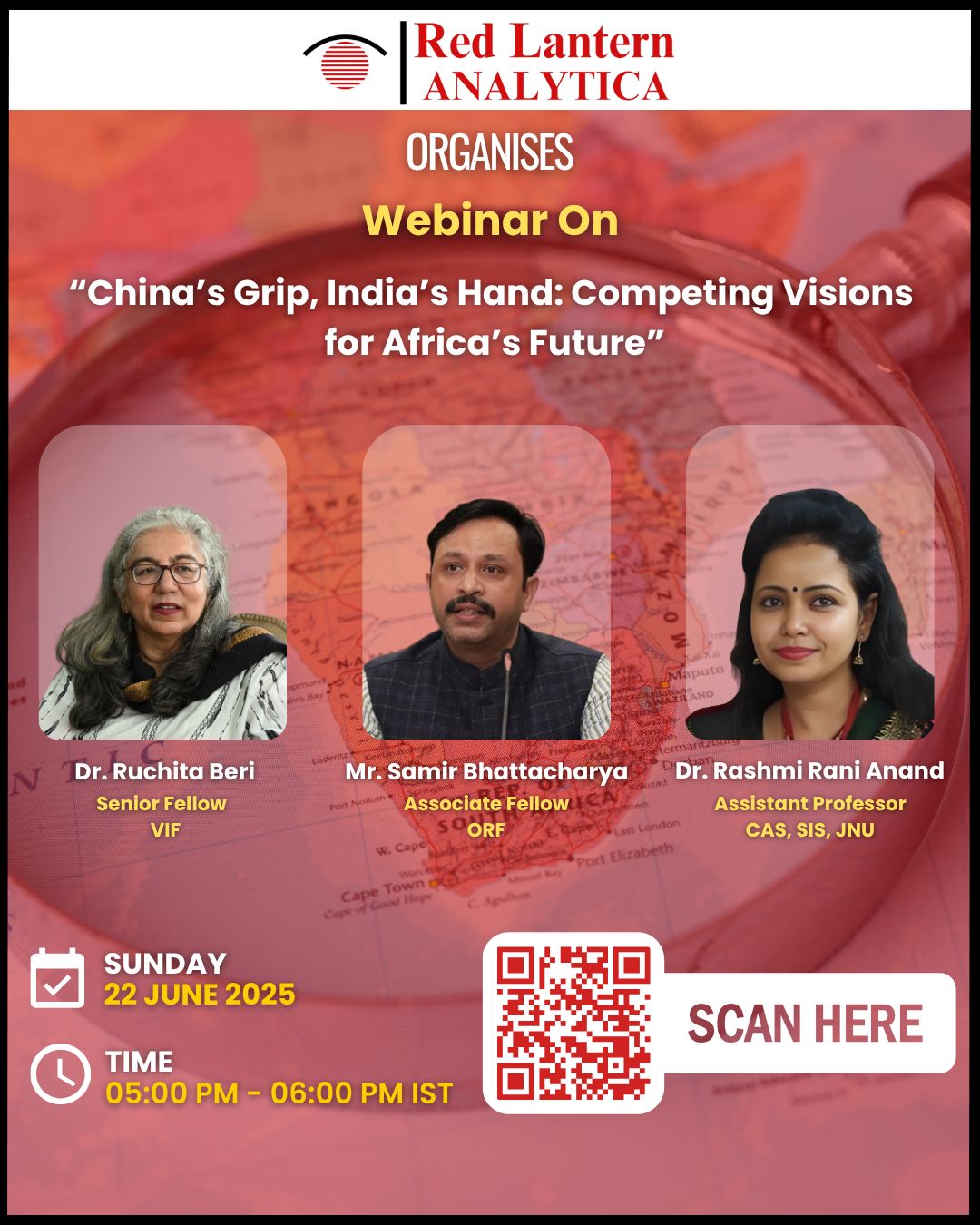
Webinar on “China’s Grip, India’s Hand: Competing Visions for Africa’s Future”
22nd June 2025
In a time when the world is paying a closer attention to the African continent, Red Lantern Analytica organised a webinar titled “China’s Grip, India’s Hand: Competing Visions for Africa’s Future” on 22nd June 2025.
The session brought together distinguished scholars and participants from across India. The distinguished panel had:
- Dr. Ruchita Beri, Senior Fellow at the Vivekananda International Foundation,
- Mr. Samir Bhattacharya, Associate Fellow at the Observer Research Foundation, and
- Dr. Rashmi Rani Anand, Assistant Professor at the Centre for African Studies, SIS, JNU.
The first speaker, Dr. Ruchita Beri, Senior Fellow at the Vivekananda International Foundation (VIF), delivered a compelling talk analysing the evolving dynamics of Africa’s international partnerships, with a particular focus on China’s expanding footprint and India’s distinctive approach to engaging with the continent.
Dr. Beri began by examining China’s economic and political influence in Africa, emphasizing Beijing’s strategic efforts to broaden its presence across the region. Through a combination of aggressive trade policies, large-scale infrastructure projects, and investments in natural resource extraction, China has established itself as a dominant external actor in African affairs. She noted that this engagement is largely state-driven, with Chinese government-backed entities playing a central role in financing and executing development projects. While this model has brought visible infrastructural benefits, it has also raised concerns about debt dependency, lack of local capacity-building, and limited long-term economic sustainability.
In contrast, Dr. Beri highlighted India’s approach to Africa, characterizing it as more people-centric and collaborative. Unlike China’s state-led strategy, India’s partnership model is rooted in the priorities of African nations themselves. “India’s engagement is not just about economic returns,” she remarked, “but about building long-term, sustainable partnerships that respond to African aspirations.”
She elaborated on three key pillars of India’s Africa policy:
- Capacity Building and Skills Development – India has invested significantly in training programs, scholarships, and technical cooperation to empower African human capital. Initiatives such as the Indian Technical and Economic Cooperation (ITEC) program have become hallmarks of this people-to-people engagement.
- Private Sector Participation – Indian businesses have increasingly made inroads into African markets, particularly in sectors like pharmaceuticals, IT, and agriculture. Unlike China’s reliance on state-owned enterprises, India’s Africa strategy is led by private entrepreneurs, creating opportunities for inclusive economic development.
- Civilian Oversight and Grassroots Engagement – Dr. Beri noted that India’s partnerships often emerge from civil society collaborations, academic exchanges, and diaspora linkages, reinforcing a bottom-up approach to diplomacy that resonates with local communities.
Dr. Beri concluded by affirming that while both India and China are key external players in Africa, their engagement models differ fundamentally. China’s economic interests dominate its policy, whereas India’s approach is more aligned with African development goals and societal empowerment.
The 2nd Speaker – Mr. Samir Bhattacharya, Associate Fellow, ORF opened his remarks examined China’s rising footprint in Africa, driven primarily through large-scale infrastructure investments and concessional loans. He pointed out that China’s presence is visible in nearly every corner of the continent, from transport networks and industrial parks to energy and mining sectors. While these projects have accelerated infrastructure development in many African nations, Mr. Bhattacharya emphasized that the terms of Chinese loans often lack transparency and come with conditionalities, which can undermine national sovereignty and burden local economies with unsustainable debt.
Crucially, Mr. Bhattacharya noted a shift in recent years, highlighting the emergence of greater African agency in international partnerships. “African countries are no longer passive recipients of foreign aid and investment,” he said. “They are increasingly scrutinizing their external engagements and recalibrating their partnerships to align with national interests.” This, he argued, is influencing how nations like China and India are received and perceived across the continent.
Turning to India-Africa relations, Mr. Bhattacharya drew a clear contrast between China’s state-centric, top-down approach and India’s more balanced, market-driven model. He described India’s engagement with Africa as rooted in cooperation rather than domination, emphasizing mutual respect, shared democratic values, and a deepening people-to-people connection.
He highlighted three key aspects of India’s Africa policy:
- Transparent and Demand-Driven Investment – Unlike China’s model, India’s investments are guided by market forces and African priorities, reducing risks of debt dependency and promoting equitable growth.
- Respect for Sovereignty – India’s approach steers clear of imposing political conditions or opaque loan terms. Instead, it focuses on creating win-win partnerships where African governments retain decision-making authority over their development agendas.
- Strategic Alignment Without Overreach – Mr. Bhattacharya emphasized that India does not seek to dominate Africa geopolitically but rather aims to be a trusted development and trade partner, particularly in areas like technology, health, digital infrastructure, and education.
In his concluding remarks, Mr. Bhattacharya called for a nuanced understanding of Africa’s geopolitical evolution, stressing that future global engagement with the continent must prioritize local ownership, sustainability, and long-term development over short-term strategic gains.
The final speaker, Dr. Rashmi Rani Anand provided critical insights into India’s strategic partnership with Africa, especially in the context of green energy transitions and the rising influence of global powers such as China on the continent.
Dr. Anand emphasized that Africa holds immense strategic value for India, particularly due to its abundance of critical minerals essential for green energy technologies, including lithium, cobalt, and rare earth elements. These resources are pivotal as India pursues ambitious climate goals and transitions toward renewable energy.
She underscored that India’s engagement with Africa is not symbolic but rooted in real South-South cooperation, built on principles of equality, mutual respect, and shared development priorities. “This is not just a policy on paper,” she noted. “India is deeply committed to empowering Africa through capacity building, technology transfer, and sustainable development initiatives.”
In stark contrast, Dr. Anand addressed the implications of China’s deepening investments in African infrastructure and technology sectors, particularly under the Belt and Road Initiative (BRI). She pointed out growing concerns related to sovereignty, debt distress, and lack of transparency in Chinese-funded projects. These concerns are amplified by the opaque nature of financing terms, tied aid, and the long-term strategic control that often accompanies such investments.
Key takeaways from Dr. Anand’s address include:
- India’s Youth-Focused, Demography-Aligned Engagement – India recognizes Africa’s growing youth population and is working collaboratively on education, skilling, and entrepreneurship initiatives that leverage this “youth bulge” for shared demographic advantage.
- Sustainable Capacity Building – Unlike infrastructure-heavy models, India emphasizes capacity building for sustainable development, helping African nations diversify their economies beyond raw materials and resource exports. This includes support in governance, education, healthcare, and SME development.
- Respect for Sovereignty and Local Priorities – India’s model is non-intrusive, avoiding political interference and offering assistance that respects national priorities and local ownership.
Dr. Anand concluded that India’s Africa policy must remain people-centered, transparent, and adaptive to evolving regional needs. As global powers vie for influence in Africa, India’s comparative advantage lies in its ability to build trust-based, equitable partnerships.
During the Q&A session, participants posed thoughtful questions regarding India’s potential in Africa. The session was ended by the delivery of Vote of Thanks from Aritri Roy, a team member from RLA.