
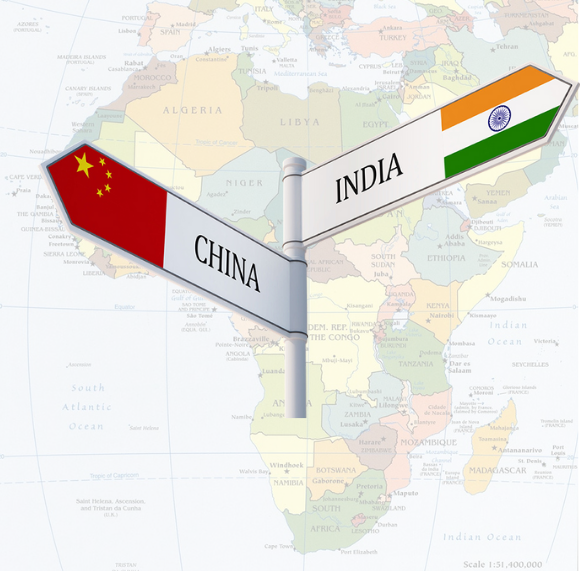
In 2023 the world witnesses a watershed moment in geopolitics when under the presidency of India. The African Union joined the G20. This move was more than symbolic as it reflected the continent’s growing geopolitical relevance and the shifting axis of global power toward the Global South. But this inclusion also sharpened the spotlight on a silent contest already underway between China’s entrenched presence and India’s expanding engagement across Africa. With historical ties, soft power, and developmental diplomacy as key levers, India is now confronted with both an opportunity and a challenge as to how to engage a rising Africa without becoming a shadow of China’s state-capitalist model.
While both India and China deploy state-backed finance to win friends and advance strategic interests in Africa, their approaches differ fundamentally in structure, cost, transparency and developmental impact. India primarily offers concessional Lines of Credit (LoCs) through EXIM Bank at low (1-2%) or zero interest rates, which often carries a long repayment horizon (15–20 years) with grace periods of 5–7 years. By keeping projects untied and rates concessional, Delhi minimizes the risk of debt distress and asset-for-debt swaps. China’s commercial interest rates can run as high as 3–6%, with ballooning penalty structures for delayed service, and shorter tenors (5-10 years) with minimal or no grace period. India does not wait for a country to default in order to extract political or territorial concessions. China on the other hand holds sway through “debt-for-equity” or “resource-backed” clauses: inability to service debt can lead to control of railways, ports or energy assets. This divergence in approach is increasingly resonating with African nations that are now seeking sustainable development rather than debt dependency.
China’s ties with Africa dates back to 1950s when it supported post-colonial liberation movements in Africa. Since the early 2000s, China’s involvement at just face value has been nothing short of transformative in scale. Through initiatives like the Belt and Road Initiative (BRI) and the Forum on China-Africa Cooperation (FOCAC), being has poured over 180 billion dollars into the continent, financing over 3000 infrastructure projects. From railways in Kenya and Nigeria to ports in Djibouti and pipelines in Angola, China’s infrastructural footprint spans virtually every corner of Africa. The Addis Abba-Djibouti railway, the Nairobi-Mombasa Standard Gauge railway, and the massive hydropower dams in Zambia and Ethiopia are often cited examples of China’s visible contributions. However, behind the concrete and steel lie contracts laced with opacity, commercial loans with steep repayment terms and a financing model that increasingly resembles a predatory web. A growing number of African nations have found themselves ensnared in what is now referred to as China’s ‘debt-trap diplomacy’. The pattern is consistent, Beijing provides large loans with high commercial interest rates and short repayment windows, often secured against strategic national assets or resources. Crucially, these contract are shrouded in secrecy, rarely disclosed to parliaments or the public. The execution of the projects is dominated by Chinese state-owned enterprises, which import Chinese labour and materials, limiting the developmental spill overs for local economies.
Djibouti is one of the clearest examples of Chinese debt-trap diplomacy. The small horn of Africa, strategically located at the mouth of the Res Sea, owes more than 70% external debt to China, largely tied to infrastructure projects like the Doraleh Multipurpose Port and the Addis Abba-Djibouti railway. In exchange of these investments, Djibouti granted China the rights to build its first overseas military base therefore serving geopolitical purposes for Beijing. Similarly, Zambia borrowed billions from Chinese lenders notably for Kariba Dam rehabilitation and the Kenneth Kaunda International Airport expansion, which finally led to it becoming the first African country to default on its debt. Under a ‘resource-backed loan’ model, Angola too pledged its future oil revenues to repay loans extended for roads, hospitals and office buildings. This arrangement has left Angola with crippling debt, poverty, illiteracy, and reduced fiscal flexibility. Kenya suffers the same dilemma as the Chinese funded Standard Gauge Railway has now pushed the country’s public debt to over 70% of its GDP. By 2017, the Republic of Congo’s debt had ballooned to over 115% of GDP, one of the major reasons for which was the weight of large debts to China. This situation was seen as a test case for International Monetary Fund, as it had issued a bailout for Congo, and many believed more countries in the African continent are going to turn to IMF for the very same reason. While Chinese investments have undeniably built roads, railways, and ports across Africa, the long-term development benefits remain highly questionable. In many cases, the infrastructure does not translate into real economic transformation due to poor integration, unsustainable financing, and low local ownership. The debt-trap narrative is not just rhetoric it is a real phenomenon that is stalling African development and threatening sovereignty.
On the other hand, India’s relations with Africa is marked by long-standing, historical, emotional and ideological roots. While China has been treating Africa as investment, India is treating Africa as a partner. As several African countries grow wary of China’s opaque loans and aggressive asset control tactics, India is seizing the opportunity to position itself as a genuine development partner. This is most visible in its expanding presence in East, West, and Southern Africa. One of the most prominent examples of India’s constructive engagement is Ethiopia, where India has invested 5 billion dollars in pharmaceuticals, textiles, and agriculture, making it among the top three foreign investors. The Ethio-India Innovation Centre is a symbol of India’s focus on tech-driven, locally adapted development. India’s Lines of Credit worth over $12 billion have supported more than 200 projects in over 40 African countries like Kenya, Tanzania, Ghana etc. These projects are transparent, demand-driven, and mostly untied, meaning African nations choose their contractors and design the scope of the projects, avoiding the pitfalls of Chinese dependency on its own companies and labour. India financed the sectors like healthcare, and renewable energy in Uganda, areas often neglected by China. Under Vaccine Maitri, India has also been instrumental in supplying affordable medicines and vaccines to countries like South Africa, Botswana, Mauritius, Namibia etc. Moreover, the Pan-African-e Network Project linked 53 African countries to Indian hospitals and universities through satellite and fibre-optic infrastructure.
However, India’s engagement with Africa, is modest in scale than China, and therefore India must do more to scale up and systemise its engagement. While Indian projects are more sustainable and appreciated on the ground, they often lack the visibility and speed of Chinese infrastructure diplomacy. To strengthen its strategic edge, India needs to streamline its concessional financing procedures through the EXIM Bank, increase its diplomatic presence with more embassies and cultural centres across the continent, and build regional development hubs in partnership with the African Union (AU). The inclusion of Africa in G20 presents new opportunities for Delhi to become a long-term partner of choice for Africa and push for African priorities assertively in global stage. Both the countries can therefore offer a respectful and mutually beneficial model that empowers rather than entrapping.

Samayeta Bal (Advocate enrolled with the BCI, LAMP Fellow 2024-25)
An advocate and a public policy professional with penchant and knowledge of both the worlds. She writes in topics pertaining to public policy, geopolitics and international relations.
